Since
Since  Since
Since Spiral Heat Exchanger
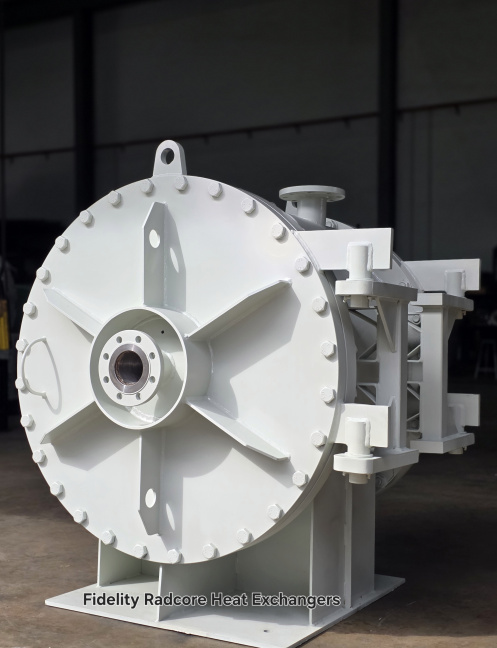
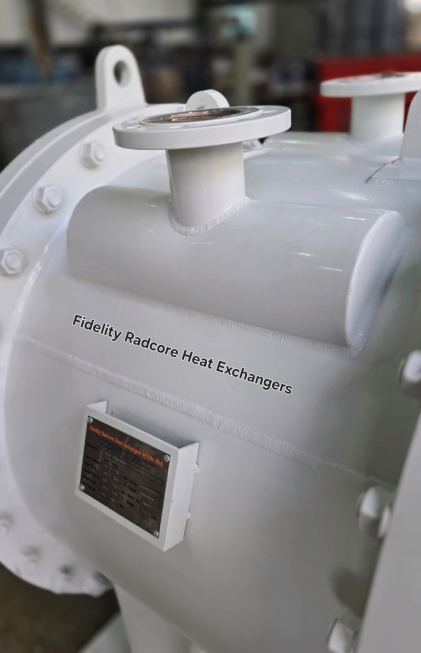
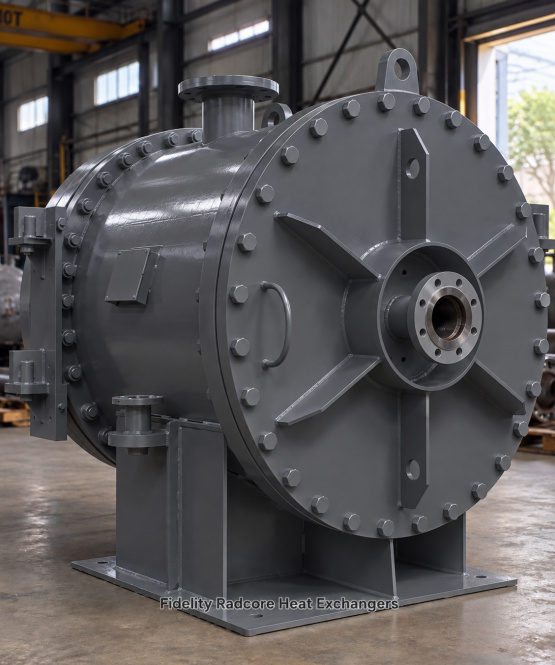
FRHE is able to design and supply Spiral Heat Exchangers for demanding industrial applications involving fouling fluids, viscous liquids, slurries, sludge and process streams containing suspended solids or fibres.
A Spiral Heat Exchanger consists of two metal plates which are formed and wound around a central core to create two separate concentric spiral flow channels. The hot and cold fluids travel through their respective channels without mixing and heat is transferred continuously across the separating plate.
The spiral arrangement provides a continuous single flow path for each fluid. Unlike conventional heat exchangers where the flow may be divided between numerous tubes or parallel channels, the entire process stream passes through one continuous channel.
This makes the Spiral Heat Exchanger particularly suitable for difficult process fluids where fouling, plugging or uneven flow distribution may otherwise become a concern. The compact construction also allows a relatively large heat transfer surface to be incorporated within a comparatively small footprint.
Suitable for Fouling and Difficult Process Fluids
One of the main advantages of the Spiral Heat Exchanger is its suitability for process fluids which have a tendency to foul conventional heat transfer surfaces. The continuously curving single-channel arrangement creates turbulence through the exchanger. If deposits begin to accumulate within the channel the available flow area becomes smaller which causes the local fluid velocity to increase. This increased velocity can help dislodge deposits and reduce the tendency for progressive fouling.
This characteristic is commonly referred to as the self-cleaning or scrubbing effect of a spiral heat exchanger.
For this reason Spiral Heat Exchangers are particularly useful for applications involving:
- Sludge
- Slurries
- Suspensions
- Fibrous liquids
- Wastewater
- High viscosity fluids
- Non-Newtonian fluids
- Liquids containing suspended solids
- Process streams with a high fouling tendency
Characteristics of our Spiral Heat Exchanger
Depending on the application FRHE Spiral Heat Exchangers can offer the following characteristics:
- Continuous single-channel flow arrangement
- Good resistance to fouling and plugging
- Self-cleaning effect under suitable operating conditions
- High turbulence and good heat transfer performance
- Compact construction
- Relatively small installation footprint
- Suitable for viscous fluids and slurry services
- Suitable for fluids containing fibres or suspended solids
- Close temperature approach capability
- Counter-current flow arrangement
- Suitable for liquid-to-liquid duties
- Suitable for condensation and evaporation duties
- Low pressure drop configurations can be considered
- Removable covers can be incorporated for inspection and mechanical cleaning
- Horizontal or vertical installation depending on the application
- Custom nozzle arrangements to suit existing piping
The single-channel geometry is one of the reasons spiral exchangers are widely used for difficult fouling duties involving sludge, emulsions, fibres and particle-loaded liquids.
Materials of Construction
FRHE Spiral Heat Exchangers can be supplied in different materials depending on the process fluid, operating temperature, corrosion conditions and project requirements.
Typical materials include:
Carbon Steel
Suitable for many general industrial duties where corrosion conditions permit.
Stainless Steel 304 / 304L
Suitable for a broad range of industrial and process applications.
Stainless Steel 316 / 316L
Commonly selected where improved corrosion resistance is required.
Duplex Stainless Steel
Suitable for applications requiring higher mechanical strength and improved resistance to chloride-related corrosion.
Super Duplex Stainless Steel
Available for more severe corrosive environments where required.
Titanium
Suitable for seawater, chloride-bearing fluids and other aggressive process conditions.
Nickel Alloys / Hastelloy
Can be considered for demanding chemical or corrosive process applications.
Material selection will be reviewed according to the actual process conditions and compatibility of the fluid with the proposed construction material.
Typical Applications
FRHE Spiral Heat Exchangers can be considered for various industrial duties including:
- Process Heating
- Process Cooling
- Heat Recovery
- Sludge Heating and Cooling
- Wastewater Treatment
- Effluent Cooling
- Slurry Heating and Cooling
- Condensation
- Vapour Condensation
- Evaporation
- Thermal Oil Applications
- Chemical Processing
- Petrochemical Processing
- Palm Oil and Oleochemical Processing
- Pulp and Paper
- Food Processing
- Biofuel Processing
- Waste Treatment
- General Industrial Process Applications
Spiral Heat Exchanger for Sludge and Slurry Applications
Sludge and slurry services can be particularly challenging for conventional shell and tube heat exchangers.
Where suspended solids are present the flow can become unevenly distributed through the tube bundle. Individual tubes may gradually become restricted while the remaining fluid takes the path of least resistance through cleaner tubes.
The Spiral Heat Exchanger avoids this parallel tube arrangement by directing the process fluid through a single continuous channel. This can provide a significant operational advantage for suitable fouling applications.
Access for Inspection and Cleaning
Although the spiral configuration can reduce fouling tendencies under suitable operating conditions no heat exchanger should be considered completely immune from fouling.
Where the process fluid requires periodic mechanical cleaning the exchanger can be designed with removable covers to provide access to the spiral channel.
This allows the heat transfer surface to be inspected and cleaned using suitable mechanical or high-pressure water cleaning methods when required.
Replacement of Existing Heat Exchangers
FRHE can also review Spiral Heat Exchangers for replacement where the existing equipment has deteriorated, become obsolete or no longer provides satisfactory performance.
Where sufficient information is available the replacement exchanger can be designed around the existing operating duty, installation envelope, nozzle locations and piping arrangement.
For difficult services where an existing shell and tube exchanger experiences repeated fouling or plugging
Spiral Heat Exchanger Design & Supply
FRHE can review both new and replacement Spiral Heat Exchanger requirements based on the actual process duty and operating conditions.
For technical evaluation please provide the process fluid details, flow rates, inlet and outlet temperatures, operating pressure, design conditions, allowable pressure drop and required materials of construction.
Our engineering team can then review the application and propose a suitable configuration for the intended service.