Since
Since  Since
Since Fully Welded Heat Exchanger
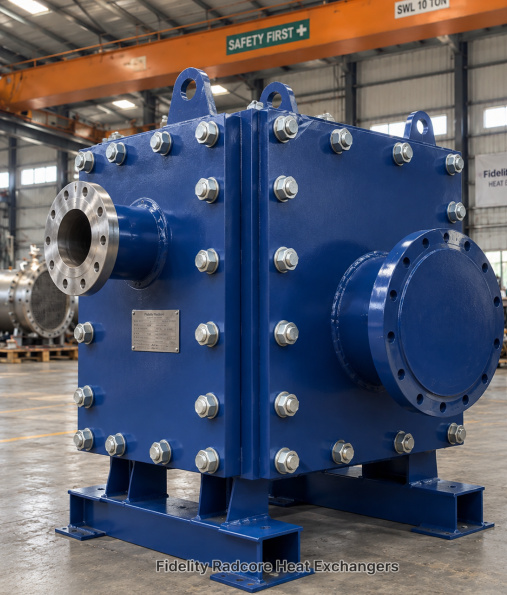
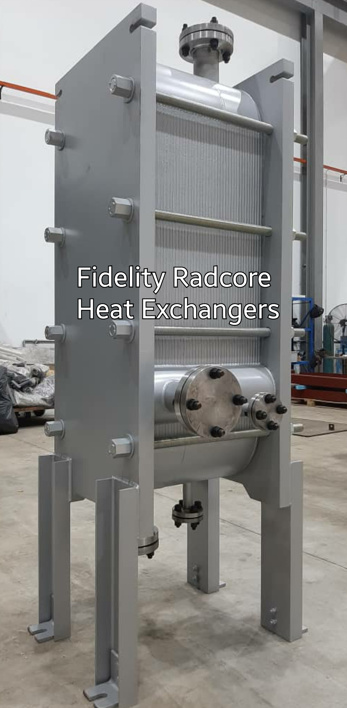
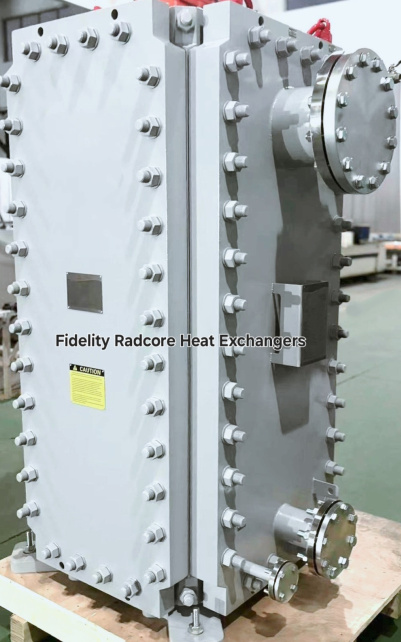
FRHE is able to design and supply Fully Welded Heat Exchangers for demanding industrial applications where high thermal efficiency, compact construction and reliable operation are required.
This type of heat exchanger uses a pack of corrugated heat transfer plates which are welded together to form alternating channels for the hot and cold process streams. The welded plate pack is then incorporated within a robust external frame to provide the necessary pressure containment and mechanical support.
The corrugated plate geometry generates a high degree of turbulence within the flow channels. This provides efficient heat transfer while allowing a relatively large thermal duty to be accommodated within a compact equipment footprint.
Fully welded exchangers are therefore particularly suitable where space is limited or where improved heat recovery and close temperature approach are important process considerations. Comparable welded block designs are widely used for single-phase and two-phase process duties including heating, cooling, condensation and reboiling.
Characteristics of our Fully Welded Block Type Heat Exchanger
Depending on the process requirement, the design can incorporate:
- Fully welded heat transfer plate pack
- Compact block type construction
- High thermal efficiency
- Close temperature approach capability
- Reduced dependence on process-side gaskets
- High turbulence within the heat transfer channels
- Suitable for higher temperature applications
- Suitable for elevated pressure applications subject to mechanical design
- Suitable for aggressive or corrosive fluids depending on material selection
- Single-pass or multi-pass configuration
- Counter-current heat transfer arrangement
- Suitable for liquid-to-liquid applications
- Suitable for condensation duties
- Suitable for reboiler applications
- Suitable for process heat recovery
- Removable access panels where required
- Mechanical or chemical cleaning provisions
- Custom nozzle orientation
- Vertical or horizontal installation depending on application
- Custom design according to individual process duty
The multi-pass arrangement can be selected independently for each process stream where required to optimise velocity, heat transfer and pressure drop. Fully welded block technology is commonly designed in this manner for duties involving unequal flow rates or demanding thermal programmes.
High Efficiency Heat Recovery
One of the major advantages of a Fully Welded Block Type Heat Exchanger is its ability to achieve high heat transfer performance within a comparatively small surface area.
The corrugated plate geometry promotes turbulence even at relatively moderate fluid velocities. This improves heat transfer while reducing the amount of heat transfer surface required for many process applications.
The compact construction can therefore provide an attractive alternative to conventional shell and tube heat exchangers where:
- Installation space is limited
- Equipment weight is a concern
- Close temperature approach is required
- Maximum heat recovery is desirable
- Existing plant capacity needs to be increased
- Space for additional conventional exchangers is unavailable
Commercial welded block heat exchangers are widely used for these reasons in energy-intensive process industries.
Process Heating and Cooling
The design is also suitable for general liquid-to-liquid heating and cooling applications.
Typical duties include:
- Process coolers
- Process heaters
- Feed preheaters
- Product coolers
- Interchangers
- Heat recovery exchangers
- Thermal oil heating and cooling
- Hot condensate heat recovery
- Waste heat recovery
Where two process streams have significantly different flow rates, separate pass arrangements can be considered to maintain suitable velocity and thermal performance on each side.
Inspection and Cleaning
Fully welded construction does not mean that the exchanger necessarily needs to be completely inaccessible.
Depending on the selected design, removable external panels can be incorporated to allow access to the heat transfer plate pack.
This can allow:
- Visual inspection
- High pressure water cleaning
- Mechanical cleaning
- Chemical cleaning
- Removal of accumulated deposits
Access requirements should be considered during the initial design stage based on the expected fouling characteristics of the process fluids.
Welded block designs with removable panels are commercially available specifically to allow mechanical inspection and cleaning of both circuits.
Replacement of Existing Fully Welded Heat Exchangers
FRHE can also review replacement requirements for existing Fully Welded Block Type Heat Exchangers.
Where the original unit has become obsolete, is no longer supported or requires replacement due to deterioration, FRHE can evaluate the available technical information and propose a suitable replacement solution.
Where required, the replacement exchanger can be engineered around:
- Existing installation dimensions
- Existing nozzle locations
- Existing piping arrangement
- Available installation space
- Original process duty
- Current operating requirements
- Revised performance requirements
The objective is to provide a technically suitable replacement while minimising unnecessary modification to the customer's existing system.
Where sufficient operating information is available, FRHE can also review opportunities to improve thermal performance or increase capacity rather than simply reproducing the original duty.
Fully Welded Heat Exchanger Design & Supply
FRHE can review both new and replacement requirements based on the actual process duty and operating conditions.
For technical evaluation, please provide the process fluid details, flow rates, inlet and outlet temperatures, operating pressure, design conditions, allowable pressure drop and required materials of construction.
Our engineering team can then assess the application and propose a suitable Fully Welded Type Heat Exchanger for the intended service.